
Security teams don’t have a visibility problem. They have a validation problem.
The data is clear. Two thirds of organisations say more than half of their findings require manual validation before anyone can act. Over half say that work exists purely to prove exploitability in their environment. Development managers won’t move without proof of exploit. And false positives remain a core challenge across more than half of all organisations.
That’s not a tooling gap. It’s a systemic failure in how we turn detection into action.
Detection scales. Truth doesn’t.
We’ve spent the last decade industrialising detection. SAST, DAST, SCA, container scanners, CVE feeds, heuristics, fingerprinting. These systems are good at one thing: answering the question “Could a vulnerability exist?”
But security decisions don’t hinge on possibility. They hinge on reality. Is the vulnerable path reachable? Can it be exploited in this environment? What controls are already in place?
Take a scanner flagging a critical Apache Struts vulnerability. In practice, the module might be disabled. A WAF may block the exploit payload. The app may sit behind authentication. The vulnerable path may be unreachable entirely. The result is a “critical” finding with little or no real risk. At scale, this creates noise — and noise is the enemy of action.
False positives are a trust problem, not just an efficiency problem
When engineers repeatedly see findings they can’t reproduce, vulnerabilities that don’t exist in context, and duplicate or stale alerts, they adapt in predictable ways. Remediation slows. Tickets get deprioritised. SLAs become performative. Security loses influence.
At that point, vulnerability management becomes what many quietly acknowledge it already is: compliance theatre.
Validation isn’t just about accuracy. It’s about restoring trust between security and engineering. Without that trust, even real vulnerabilities struggle to get fixed.
Today’s environments make validation harder
Validation used to be a simple question: can I exploit this server? Modern environments are fundamentally different. Microservices and APIs, Kubernetes, ephemeral infrastructure, zero trust architectures, identity-aware proxies, layered runtime defences. A vulnerability can technically exist but be practically irrelevant because network segmentation blocks access, IAM prevents privilege escalation, or runtime controls neutralise the exploit.
Validation now requires understanding architecture, identity flows, service-to-service communication, and runtime behaviour. It’s no longer a scanning problem. It’s a systems problem.
Severity is not the same as risk
CVSS was designed for standardisation. In practice, it often obscures reality.
A CVSS 9.8 vulnerability might be unreachable, internal-only, or buried in dead code. Meanwhile a moderate-severity finding might expose sensitive customer data, enable lateral movement, or serve as a pivot point in a larger attack chain.
What matters is contextual exploitability: Is the asset exposed? Is the path reachable? What controls are in place? Can this be chained with other weaknesses? That’s the difference between theoretical risk and operational risk.
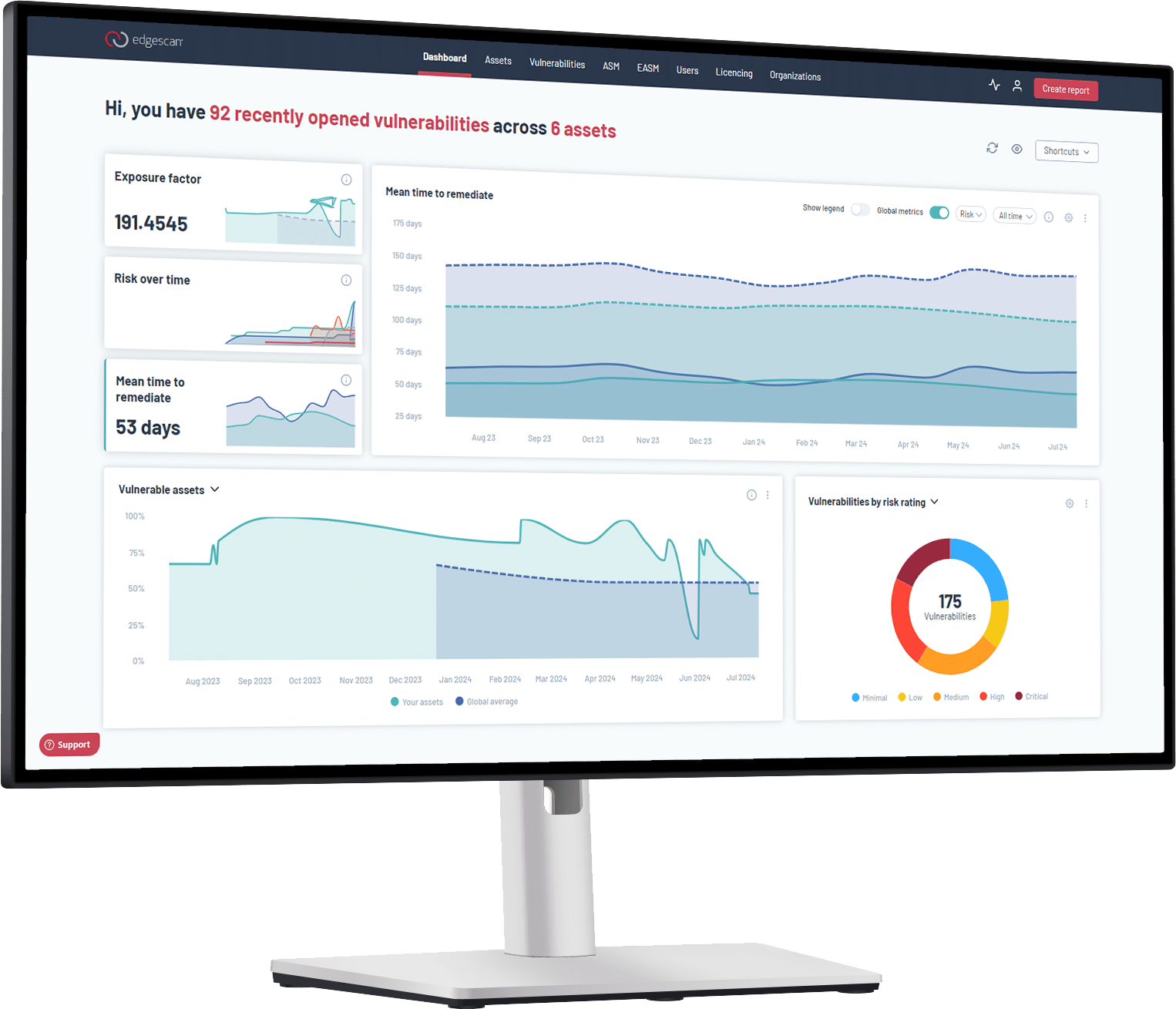
Edgescan’s EXF (eXposure Factor) score combines CVSS, EPSS, CISA KEV, and AI threat intelligence to surface this kind of contextual risk. It’s why our data consistently shows a small percentage of findings driving the majority of real exposure. In our 2026 Vulnerability Statistics Report, 6.2% of vulnerabilities are linked to active ransomware campaigns. A score that doesn’t surface that signal is missing what attackers already know.
Safe validation is a compromise
True validation often means doing what attackers do: executing payloads, testing bypasses, simulating exploitation. But production environments are fragile. Systems can crash. Data can be corrupted. Customer experience can be impacted.
So organisations compromise. Non-invasive scanning. Safe checks. Best-effort validation. And with that compromise comes uncertainty. The more carefully you validate, the less certain your conclusions. It’s a tension with no clean resolution — only better or worse management of it.
Assessments go stale fast
Even when a vulnerability is assessed, that assessment can quickly become outdated. New exploits are released. Mitigations degrade. Infrastructure changes. Permissions shift. An internal-only vulnerability can become critical overnight because of a cloud misconfiguration or a VPN exposure.
Validation isn’t a point-in-time activity. Organisations that treat it as one are working from stale intelligence.
Manual validation doesn’t scale
If validation takes five minutes per finding, 100,000 findings is more than 8,000 hours of work. Large enterprises deal with millions of assets and constantly changing infrastructure. Manual approaches don’t hold up.
Automation helps, but introduces incomplete context, incorrect assumptions, and probabilistic results. Neither extreme solves the problem. What’s needed is validated, human-confirmed findings — not raw scanner output — feeding into a risk-scored priority queue.
Attackers think in paths, not CVEs
Modern attackers chain together weak IAM, exposed APIs, SSRF vulnerabilities, credential reuse, and privilege escalation. Individually, each element may look low risk. Together, they create critical exposure.
Validation needs to evolve from verifying individual vulnerabilities to understanding attack paths and chaining potential. That requires graph modelling, environmental awareness, and dynamic analysis — far beyond what traditional scanners were built to do.
Developers now demand proof
Engineering teams are no longer passive recipients of vulnerability tickets. They ask whether you can prove exploitability. They want to see the attack path. They ask what the real impact is and whether they can reproduce it.
They’re right to ask. In a world of limited engineering bandwidth, proof is the currency of prioritisation. A CVE alone isn’t persuasive. Evidence is.
AI accelerates the problem on both sides
Attackers and defenders now both use AI: automated exploit development, rapid reconnaissance, attack path generation, probabilistic validation. But AI also introduces hallucinated exploitability, incorrect assumptions, and false confidence.
Which creates a recursive problem: who validates the validator? As AI becomes more embedded in security workflows, trust in outputs becomes more critical, not less.
The economics are the real issue
Detection is cheap and scalable. A scanner can generate millions of findings in hours. Validation is expensive and complex. Proving exploitability, reachability, and business impact requires deep environmental context, runtime analysis, and sometimes active testing.
This asymmetry is what creates backlog, burnout, and wasted remediation effort. Until the gap closes, the problem compounds.
From counting vulnerabilities to understanding exposure
The industry is shifting from counting vulnerabilities to understanding exposure. This is what underpins attack surface management, continuous threat exposure management (CTEM), and risk-based prioritisation.
Not all vulnerabilities matter equally. Validation is the mechanism that determines which ones do. The organisations closing vulnerabilities fastest aren’t the ones with the most resources — they’re the ones working from clean, validated, well-prioritised data.
We’ve spent years asking how to find more vulnerabilities. The better question is: how do we prove which ones matter?
In modern AppSec, the organisations that win won’t be the ones that detect the most. They’ll be the ones that can confidently act on the right ones.
To see how Edgescan validates what actually matters, request a demo.