

I have some version of this conversation most weeks. Someone wants to know what a continuous threat exposure management (CTEM) program actually involves, beyond the acronym.
The short answer is that we can take you through the full life of a vulnerability. Find the things you own. Work out how each one should be tested. Test it. Then give you enough information to do something about it.
You cannot test what you do not know you own
This is where most programs stall, and it stalls quietly.
Organizations come to us with an asset count. Then we run discovery across their external estate, and the number is bigger. Sometimes much bigger. One financial services client came to us confident about their API footprint and found the real number was more than twenty times what they expected.
External attack surface management is how we get that number. It runs continuously against the internet rather than against your inventory, so it needs no prior asset list and no credentials to start. It enumerates subdomains, resolves DNS records, and pulls certificate data tied to your domains, which surfaces the web-facing assets your inventory never captured, including shadow IT and rogue APIs.
Anything it finds moves straight into the program. There is no separate onboarding step, which matters, because a discovery process that creates a backlog of paperwork tends to get run once.
Nobody is being careless. There are only a few ways this happens, and they are all mundane.
Things got built before anyone was tracking properly, and that history goes back decades at a large organization. Developers built things and left, and nobody inherited the record. Or ownership was assigned so loosely that when you point at an asset and ask whose it is, three teams look at each other.
The bigger and older the organization, the wider the gap. We see it at some of the most mature security programs in the world.
Then decide what each thing warrants
Discovery produces a list. The list is not the point. What matters is sorting it, and in practice everything discovered falls into one of four categories.
Decommission. If a domain was never meant to be public-facing, taking it down is the fastest way to remove the exposure. No testing required, because the asset should not exist.
Monitor. Some domains are intentionally public but present no meaningful surface. A domain bought defensively against typosquatting is the common example. Watch it, and spend your testing budget elsewhere.
Vulnerability assessment. Domains that present a potentially vulnerable surface should be tested with DAST to establish a risk profile. This is the largest category for most organizations.
Penetration test. Not every domain needs one. What drives it is usually a compliance framework, an internal standard, or an auditor asking. Beyond that, we look at what the application actually does. If it accepts file uploads, has a search function, has a login, or does anything beyond serving marketing content, it warrants a pen test. If the budget will not stretch, scan it, and understand what you are trading away.
Organizations spend a long time working this out alone. One enterprise spent a full calendar year deciding how their application portfolio should be tested. That is a year of effort before any testing improved.
Recommendations go both ways
Worth saying clearly, and honestly, because it runs against my own interest.
A penetration test is the most expensive thing I can sell you. It is also, sometimes, more than the asset needs. When we look at an environment and find something being penetration tested that does not warrant it, we say so.
That happens less often than the reverse. Most of the time we recommend more testing, not less. But it does happen, and a vendor who only ever recommends upward is not giving you an assessment.
Assess means testing it the way it should be tested
Domains that came out of analysis as a vulnerability assessment move into DAST. Domains scoped for penetration testing get a manual, hands-on-keyboard test from a CREST or OSCP certified tester.
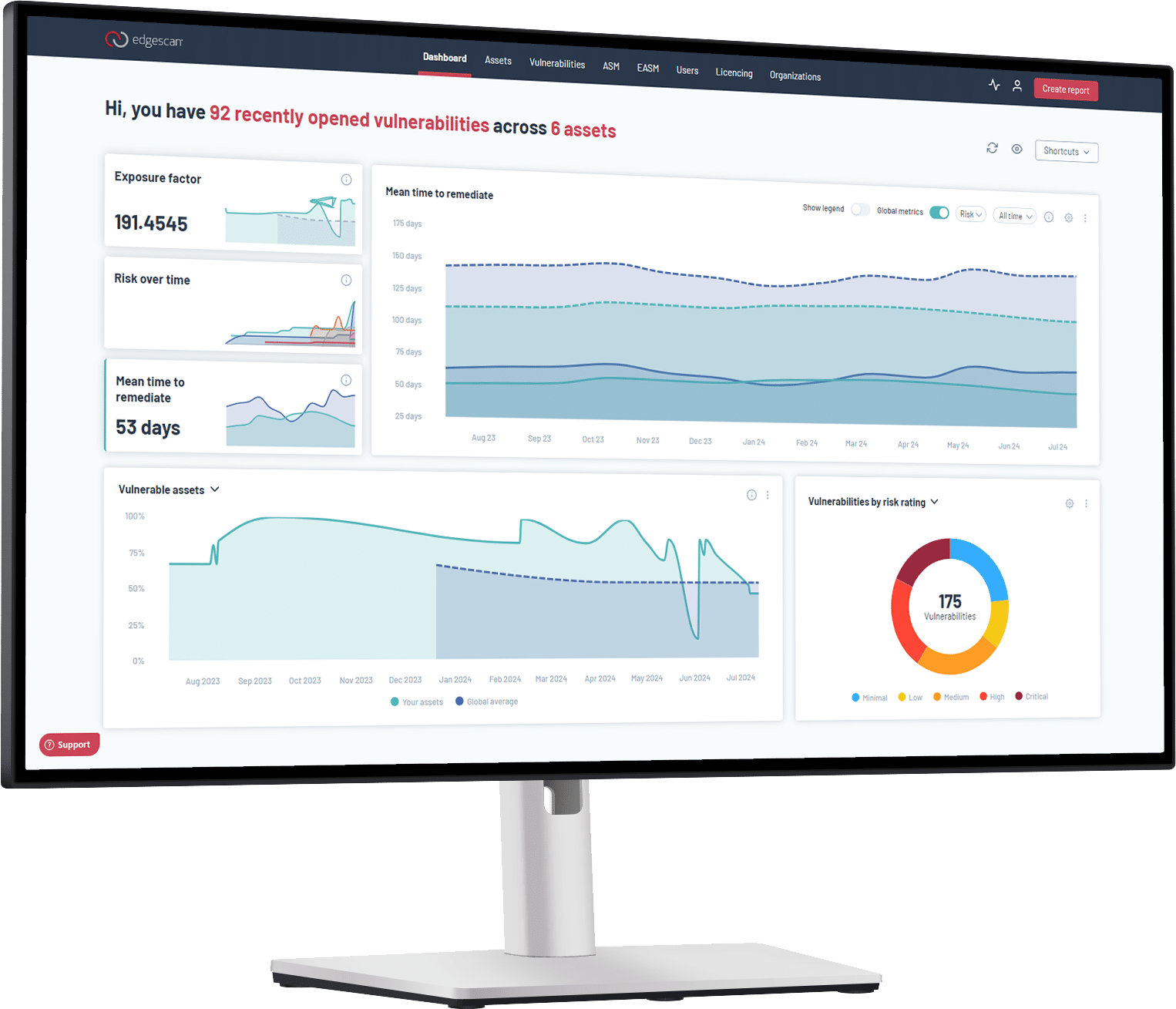
Everything that comes out of either route is validated before you see it, either automatically against our vulnerability data lake or by hand by a certified analyst. Findings are then scored using traditional risk frameworks alongside EPSS and the Edgescan eXposure Factor, so the queue reflects exposure rather than severity alone.
Retests are unlimited on every finding. That sounds like a commercial detail and it is not. When a retest costs nothing, teams verify fixes as they go instead of waiting for the next scheduled assessment to find out whether the remediation worked.
What happens after assess
We hand over findings with the context needed to act on them. Every finding comes with remediation guidance and a proof of concept built for your environment, and our penetration testers are available if that is not enough.
We do not remediate. We will help you get there, but the fixing stays with you, and any vendor offering to do both should be asked how they handle the conflict.
STo map your external attack surface and see how your assets should be tested.