

Security teams have never had more information. ASM platforms discover assets. DAST tools identify vulnerabilities. SAST, SCA, CSPM, cloud, API security and threat intelligence platforms add more data to the pile.
Finding security issues is no longer the hard part. The harder question is which exposures can actually be exploited, which ones matter to the business, and what to do about them first.
That’s where exposure validation comes in. Gartner now tracks it as a market, Adversarial Exposure Validation, and Edgescan is listed on Gartner Peer Insights, standing out from its peers for “Willingness to Recommend”.
Exposure validation moves security beyond identifying potential weaknesses toward establishing whether they represent credible, actionable risk. For Edgescan, that fits an approach built on validated vulnerability intelligence instead of more alerts. And with Edgescan Atomic and Edgescan AI Insights, the model gets stronger.
From discovery to validation
Traditional vulnerability management starts with discovery. A scanner identifies an issue, assigns a severity score and generates a finding. At enterprise scale, that can mean thousands or hundreds of thousands of results.
But a vulnerability doesn’t carry the same risk everywhere. A CVSS 9.0 on an inaccessible test system differs from the same vulnerability on an internet-facing production service known to be actively exploited. And a modest application flaw can become critical if it chains with another weakness to bypass authentication or reach customer data, it needs to be asked if the vulnerability is even exploitable.
Exposure validation asks a different set of questions. Is the exposure real? Is it reachable? Is it exploitable? Can it be chained? What is the likely impact? And does it matter to this business?
That’s the difference between finding vulnerabilities and understanding risk.
Validation has always been central to Edgescan
Edgescan combines vulnerability discovery with validation and accumulated application intelligence. Each assessment builds on what the platform already knows about the environment: applications, APIs, authentication workflows, technologies, previous findings and wider attack surface context.
That becomes more valuable as an organization scales. An enterprise with hundreds of applications doesn’t need another platform generating thousands of alerts. It needs confidence its team is spending time on exposures that are real.
The question shifts from “What vulnerabilities do I have?” to “Which of my vulnerabilities create a credible path to compromise?”
Prioritizing what matters
Validation tells you a vulnerability is real. The next question is often harder: what should I fix first?
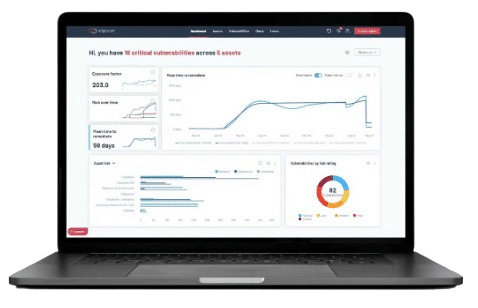
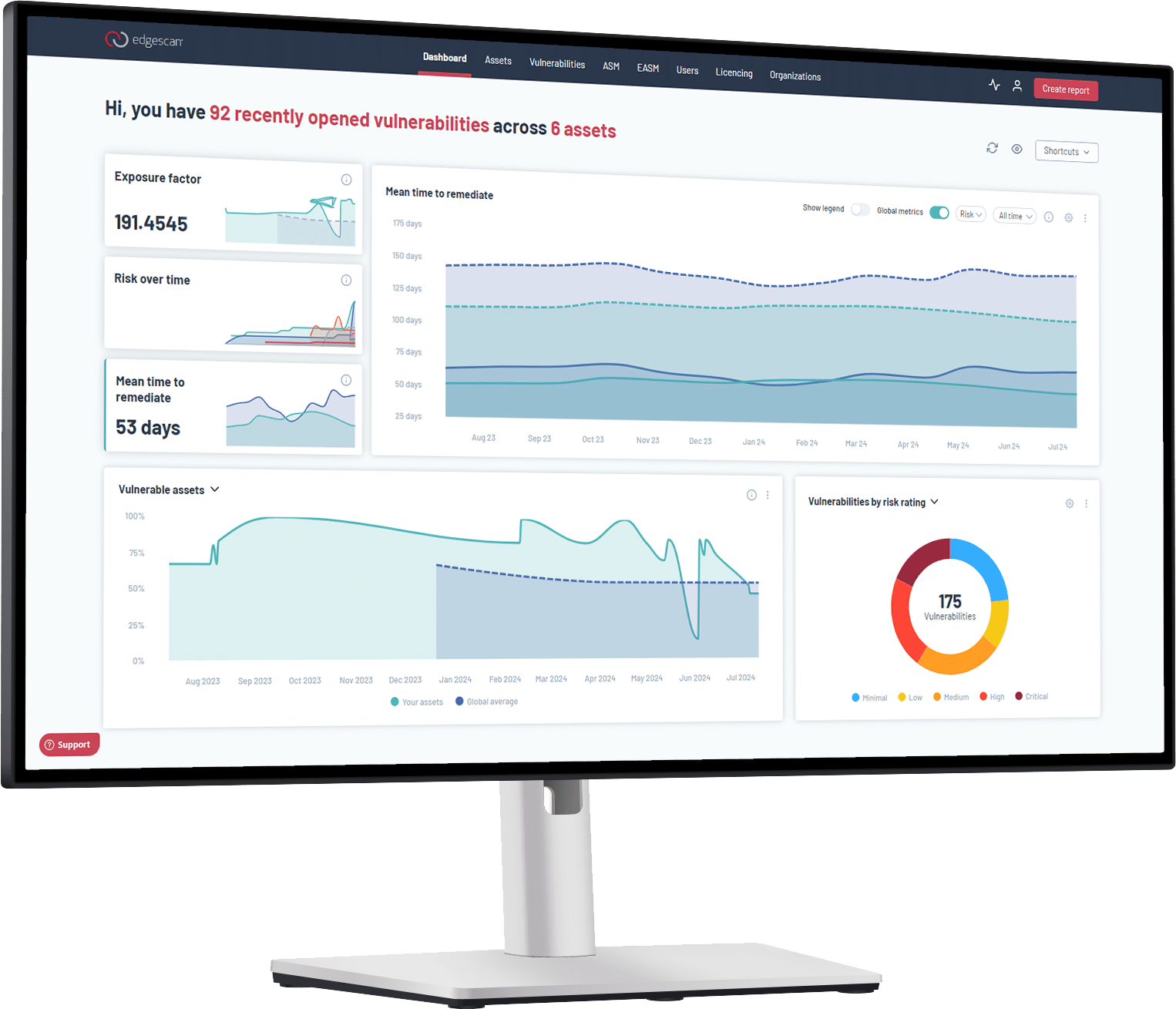
Edgescan doesn’t rely on CVSS alone. EPSS estimates the probability of exploitation. CISA KEV identifies vulnerabilities already exploited in the wild. Edgescan’s eXposure Factor (EXF) combines CVSS, EPSS and KEV status into a single score from 0 to 100, recalibrated daily as exploitation intelligence changes. Information regarding if the vulnerability is used by cyber criminals or ransomware or if there is exploit code available is also a key aspect delivered by Edgescan’s AI insights
A vulnerability with a high CVSS score may be technically severe with little evidence of exploitation. Another with a lower score may carry a high EPSS probability and appear in CISA KEV because attackers are already using it. The second one may deserve attention first.
So prioritization moves from “fix everything marked critical” to “fix the validated exposures most likely to create meaningful risk.” Teams can combine EXF with asset criticality and other context to focus on their most important applications and systems.
AI Insights: from data to decisions
Edgescan AI Insights lets security teams interrogate their exposure data directly. Instead of filtering large datasets by hand, a security leader can ask which validated vulnerabilities have the highest EXF across critical applications, which appear in CISA KEV, which high-EPSS exposures affect internet-facing assets, and what the remediation team should tackle this week. Prioritization can also draw on decision frameworks including SSVC and NIST LEV.
A CISO doesn’t need to hear there are 347 critical vulnerabilities. They need to know which exposures are most likely to be exploited, which affects the most important assets, and what to address today.
Validation establishes truth. EXF, EPSS and CISA KEV establish priority. AI Insights helps teams act on it.
Edgescan Atomic: the attacker’s perspective
A high EXF score or KEV match says an exposure deserves attention. Edgescan Atomic adds another dimension: exploitability in context. It investigates whether the exposure can be used as part of a meaningful attack path in the specific application being tested, reasoning through application behavior, authentication boundaries and business logic.
Atomic is the AI-native offensive security layer of the Edgescan platform. A conventional scanner follows predetermined logic. Atomic uses agentic AI to reason about the application, adapt as evidence emerges and investigate attack paths beyond traditional automation. It asks the attacker’s question: what can I actually do with this?
An apparent access control problem may lead Atomic to check whether another user’s records can be retrieved. An authentication weakness may prompt investigation of privilege boundaries. Several lower-severity findings may be explored together to see whether they form a more serious attack path. See for yourself!
Why the Edgescan Harness matters
Autonomous offensive security raises an obvious question: how much authority should an AI agent have?
An agent reasoning about attack paths is useful because it makes decisions dynamically. But autonomy can’t mean unrestricted execution against production environments.
Atomic reasons about what it wants to attempt. The Edgescan Harness controls what it’s permitted to execute. Scope, permissions, approved tools, techniques and rate limits are enforced outside the AI model.
The AI provides reasoning. The Harness provides deterministic control. For enterprise exposure validation, especially in sensitive or critical environments, that control layer may prove as important as the model’s intelligence.
A closed loop
Together, these capabilities form a lifecycle: discover, validate, prioritize, explore, remediate, retest.
Continuous testing discovers potential exposure. Validated findings reduce false positives and establish what’s real. EXF, EPSS and CISA KEV set priority, and AI Insights helps teams interrogate it. Atomic investigates exploitability and deeper attack paths. Expert-led penetration testing handles situations that need human judgment. Retesting verifies the fix and updates the platform’s understanding of the environment.
The result is a continuously evolving view of what’s exposed, what can be exploited, and what matters most. Periodic scans and static reports can’t offer that.
Why this matters at enterprise scale
Consider an organization managing 500 applications. Deep human penetration testing against every application every time it changes is hard to scale. Running autonomous AI testing continuously against everything may be technically possible but economically inefficient. And relying on automated scanning alone leaves gaps around business logic, attack chaining and complex application behavior.
A layered approach makes more sense. Continuous automated testing provides breadth. Atomic provides selective autonomous depth. Expert-led penetration testing provides human judgment for complex scenarios. AI Insights makes sense of the resulting intelligence.
Each type of testing goes where it fits best.
From more findings to better decisions
Cybersecurity has spent years getting better at discovering vulnerabilities. At scale, that problem is largely solved.
What organizations need now is confidence. Confidence a vulnerability exists. Confidence it can be exploited. Confidence in its potential impact. And confidence the team is fixing what matters first.
Exposure validation goes beyond proving a vulnerability exists. It shows whether it matters.
Edgescan combines validated vulnerability intelligence with EXF, EPSS and CISA KEV to help organizations prioritize real-world risk. AI Insights helps security teams interrogate and understand that exposure data. And Atomic provides autonomous offensive testing to explore what attackers could actually do with it.
Together, these capabilities move security teams from finding vulnerabilities to proving, prioritizing and acting on the exposures that matter most. Machine discovery, AI reasoning, exploit validation and intelligent prioritization, with human escalation where it’s needed.
Find what’s real. Prioritize what matters. Test what can be exploited. Fix what creates risk.
See how Edgescan validates exposure.
Want to see Atomic for yourself? Join the Atomic Under the Hood sessions and see how it works, how we keep autonomous testing safe, what we’ve learned, and how it all stacks up.