


The difference between predicting vulnerabilities and testing whether they’re exploitable
Most security teams don’t lack findings. They lack certainty about which ones are real.
AI is changing how vulnerabilities get ranked. Exposure management tools now reason across asset inventories, scanner output, CVE feeds and configuration data to predict where attack paths exist. That work has value. Ranking thousands of findings by likely impact helps teams decide where to start.
But a prediction can be confident and wrong. The tool never sends a request to the target to find out. And some questions can only be answered by sending one.
Prioritization and validation are different jobs. The difference shows up in three places: what goes in, what comes out, and how far the evidence goes.
What goes in.
A prioritization model starts from data it already holds. If the scanner produced a false positive, the model inherits it. It can move that finding higher or lower in the queue. It can’t remove it, because nothing was tested.
Testing starts from the application as it responds today: logged in, with the session carried through each step.
What comes out.
A prioritized list tells you a finding is probably important. A tested finding tells you a specific request produced a specific response, and an independent agent confirmed it before it reached the report.
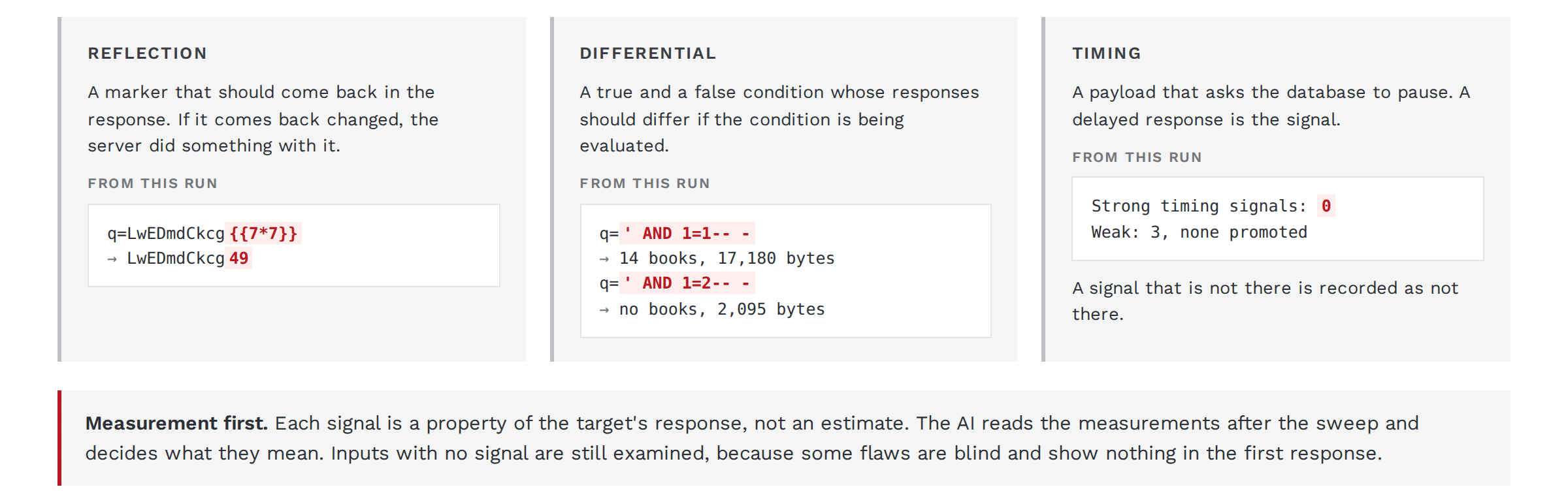
Edgescan Atomic works this way. For injection testing, the Edgescan Harness builds a catalog of every input it can reach and sweeps each one with vetted payloads. No AI is involved in the sweep. Atomic looks for three measurable signals:
- Reflection: a marker that should come back in the response
- Differential: a true/false pair whose responses should differ
- Timing: a payload that asks the database to pause
The difference is simple: Atomic isn’t just assessing the likelihood of a vulnerability. It’s gathering evidence from the application itself.
Each signal is a measurement of the target. The AI reads those measurements after the sweep and judges what they mean. Inputs with no signal still get examined, because some flaws are blind and show nothing in the first response.
How far the evidence goes.
In a September 11, 2026 assessment of Edgescan’s internal test application, Atomic’s sweep made 391 measurements across 21 input points and raised 29 strong signals.
One came from the search field. A verifier sent a random ten-character marker followed by a simple template expression: 7 times 7. If the server treated the input as plain text, the page would echo the expression unchanged. Instead, the marker came back with 49 after it. The server had evaluated the input inside its template engine.
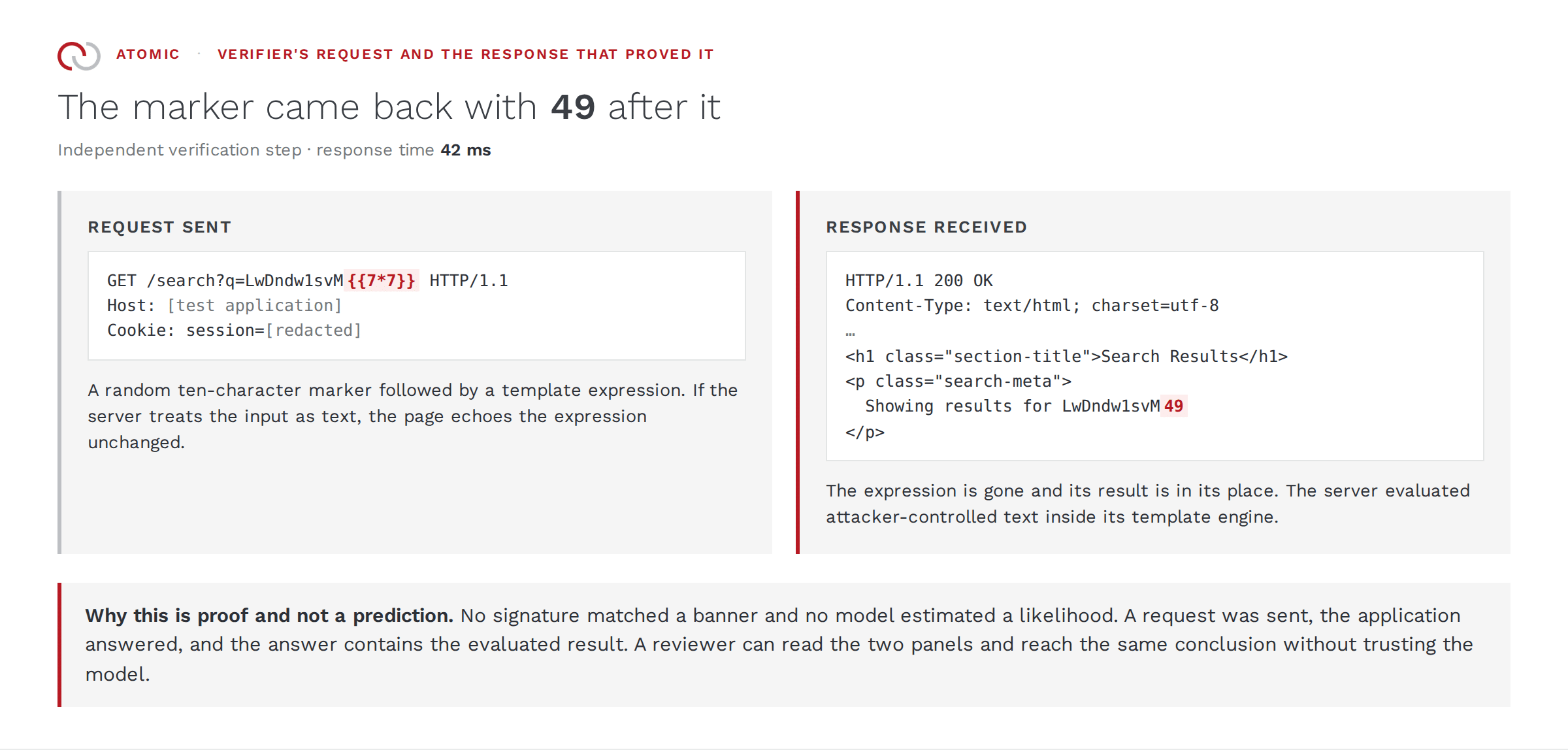
No signature matched a banner, and no model estimated a likelihood. A request was sent, and the answer contained the result. A reviewer can read both and reach the same conclusion without trusting the model.
The report stated server-side template evaluation. It also stated remote code execution was not demonstrated. The finding claimed exactly what the evidence supported, and no more.
The full run, by the numbers.
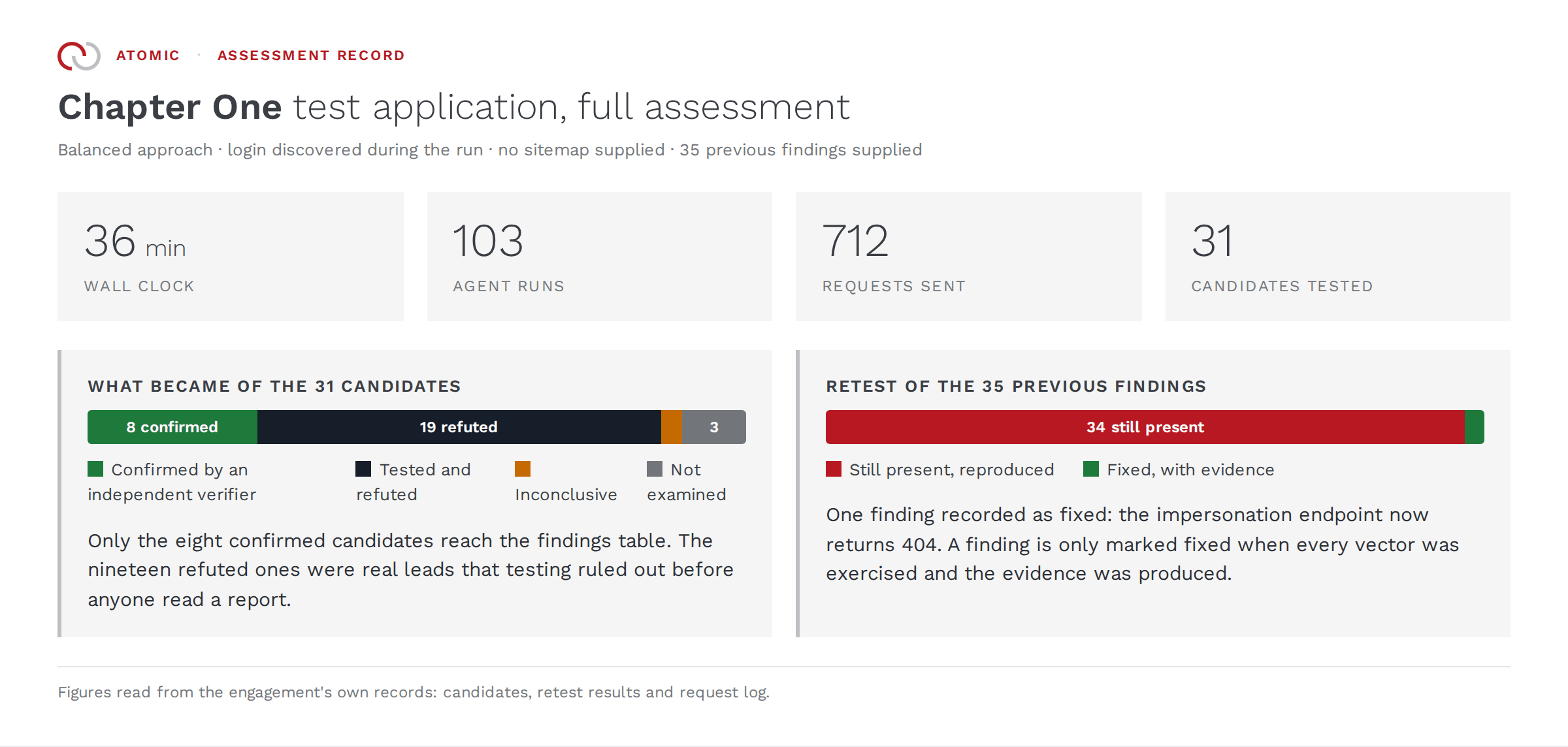
The same assessment took 36 minutes. Atomic sent 712 requests across 103 agent runs and tested 31 candidate vulnerabilities.
8 were confirmed by an independent verifier. 19 were tested and refuted. 1 was inconclusive, and 3 weren’t examined.
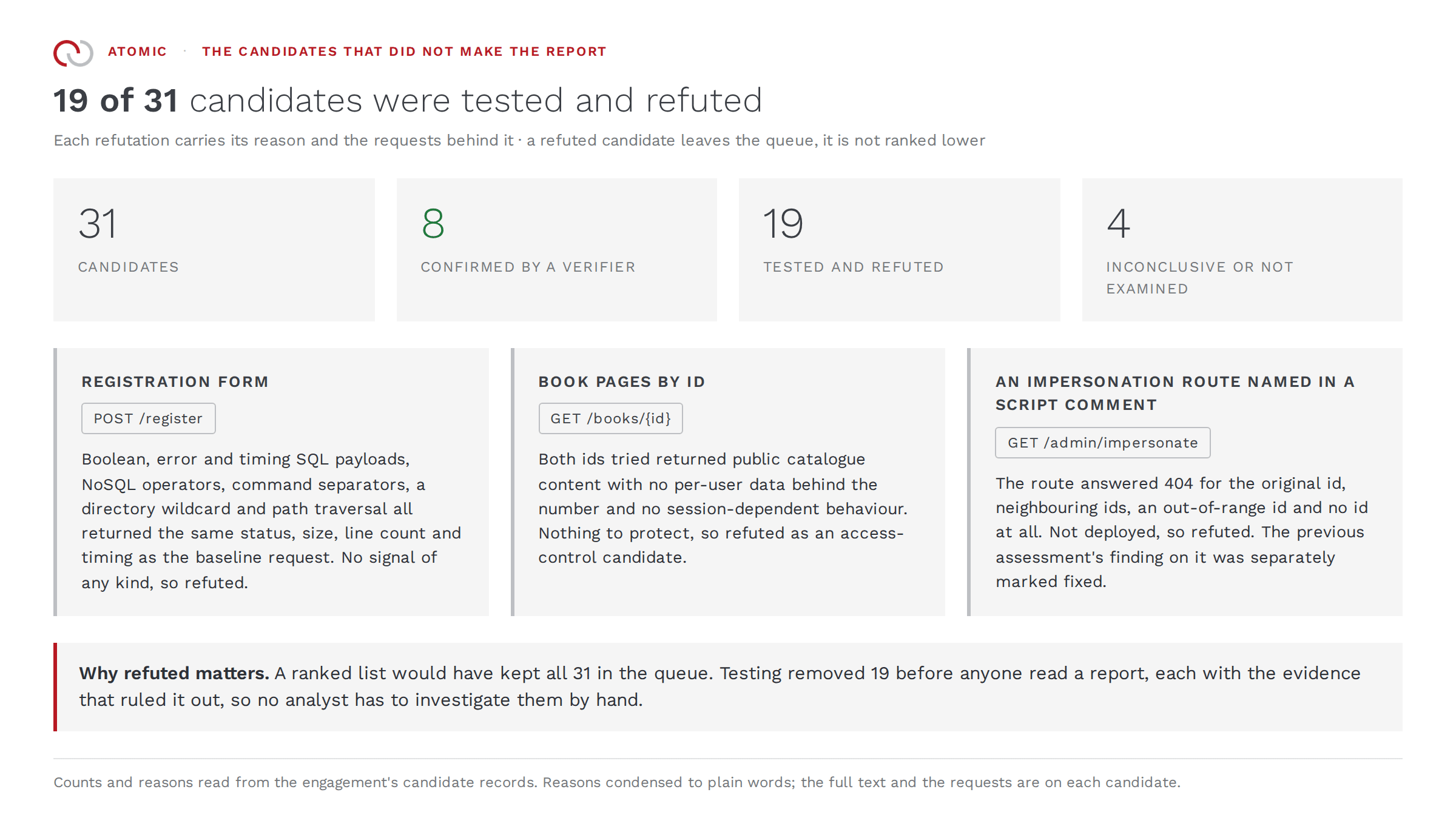
Those 19 refuted candidates are where the real value is. . They looked like potential vulnerabilities, but testing ruled them out before they reached the final report. That’s 19 findings a security team didn’t have to investigate unnecessarily.
Today, analysts do that work by hand, sorting through scanner output one finding at a time. It’s where the cost of false positives lives.
A ranked list would have kept all 31 in the queue. Only the 8 confirmed findings reached the findings table.
What proof changes.
AI can help security teams decide where to look, but knowing where to look isn’t the same as knowing what’s real. The next question for security teams shouldn’t just be how accurately a tool prioritizes risk. It should be whether the tool can show the testing, the evidence, and the verification behind its findings. Because when it comes to application security, a prediction can guide the next step. Proof tells you what to do about it.
See how Atomic proves what it finds. Book a demo.
Want to see Atomic for yourself? Join the Atomic Under the Hood sessions and see how it works, how we keep autonomous testing safe, what we’ve learned, and how it all stacks up.